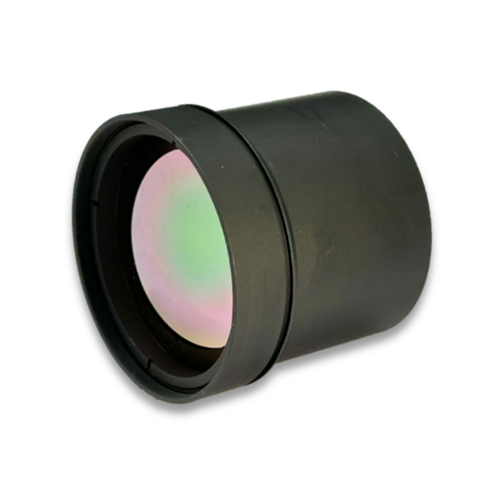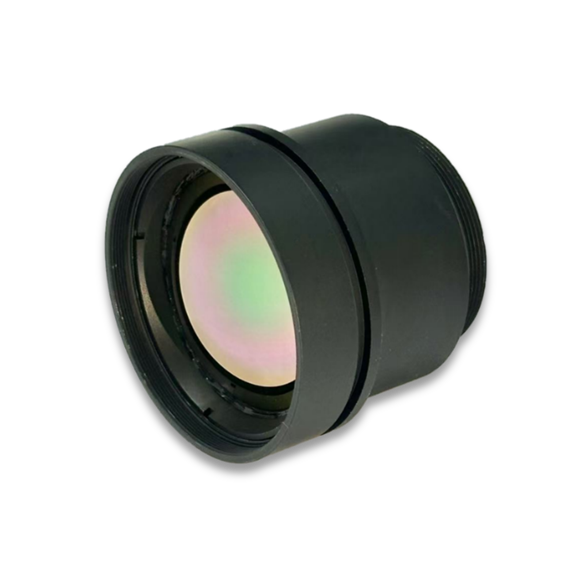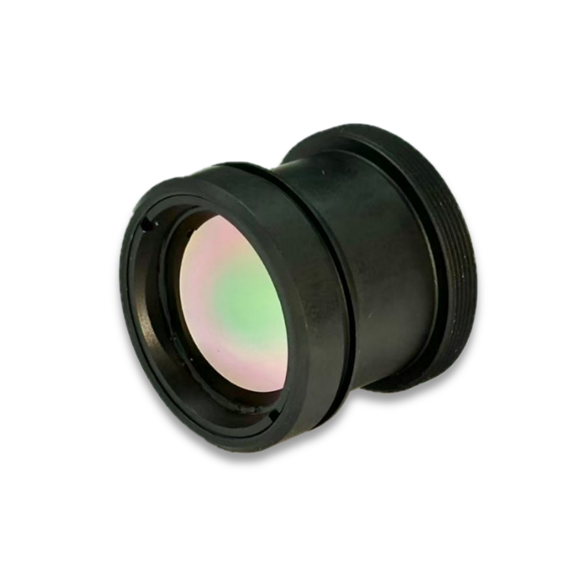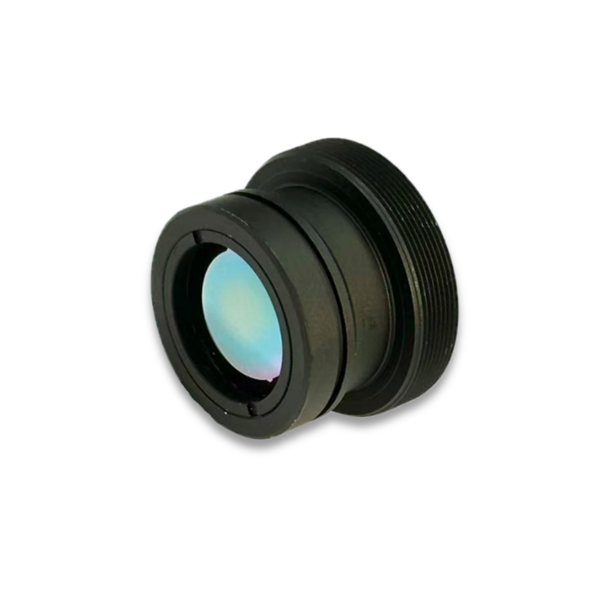
Infrared Lens Technologies & Configurations
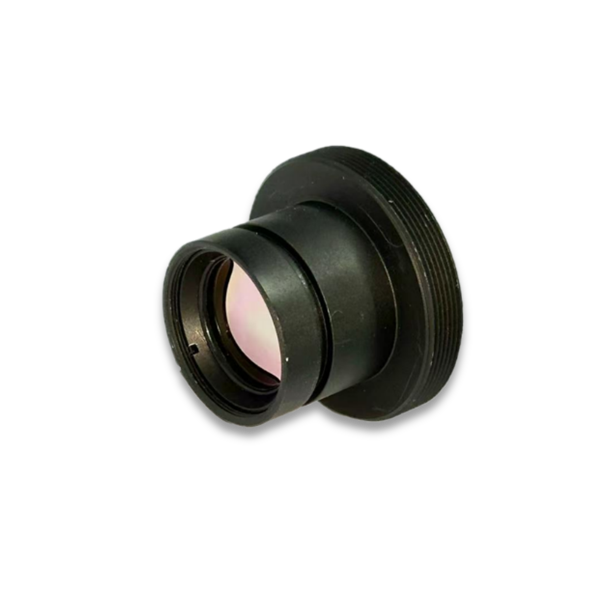
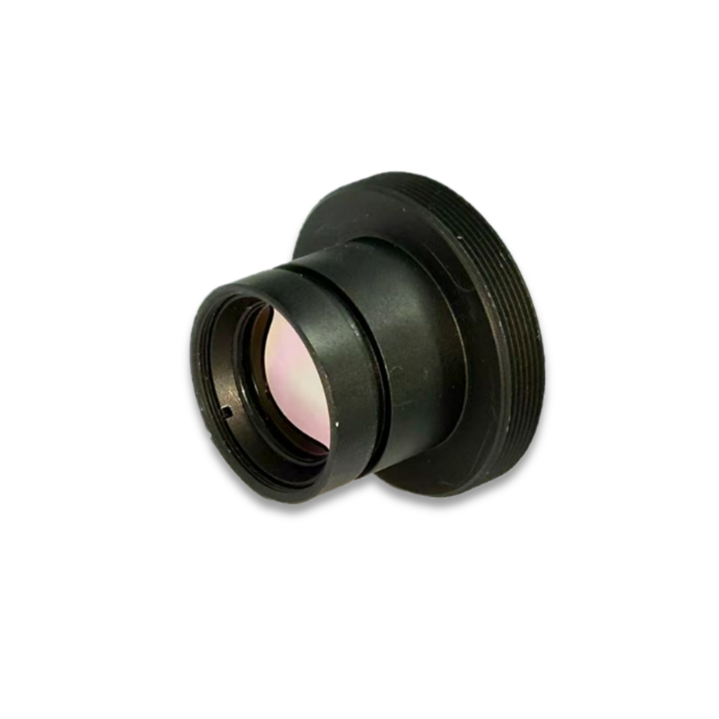
ZanVision's thermal lens portfolio provides precision infrared optics engineered for uncooled and cooled thermal imaging systems across the LWIR (8–14μm) and MWIR (3–5μm) spectral bands. These lenses are the critical front-end component of any thermal imaging system — determining field of view, detection range, optical throughput, and ultimately the system's ability to resolve thermal detail at distance.
- Spectral Band
- LWIR 8–12μm
- Lens Type
- Fixed-Focal-Length, Continuous-Zoom, Athermalized
- Focal Length
- Wide-Angle to Super-Telephoto
- Optical Material
- Chalcogenide Glass (Ge-Free)
- Coating
- DCL, HD, AR
- Athermalization
- Passive Optical/Mechanical Compensation, −40°C to +70°C
- Transmission
- ≥86% @ 8~12μm
- Application
- Security, Drone/UAV, Industrial, Maritime, Defense EO/IR
The portfolio covers fixed-focal-length lenses from wide-angle to super-telephoto, continuous-zoom lens assemblies for variable field-of-view applications, and athermalized designs that maintain focus across wide temperature ranges without mechanical compensation. All lenses are designed and fabricated with tight tolerances on surface figure, centration, and coating uniformity to maximize transmission and minimize stray light.
Lens Materials and Coating Technology
Thermal imaging lenses operate in wavelength regions where conventional optical glasses are opaque. Instead, infrared-transmissive materials are used:
- Germanium (Ge): The workhorse material for LWIR optics, with high refractive index (n≈4.0) enabling compact lens designs. High transmission across 2–14μm. Requires anti-reflection coating due to high surface reflectivity (≈36% per uncoated surface).
- Chalcogenide Glass: A family of amorphous materials (Ge-As-Se, Ge-Sb-Se compositions) with lower dn/dT than germanium — approximately 1/10th the thermal-optic coefficient. This property enables passive athermalization, eliminating the need for mechanical focus compensation across temperature swings. Chalcogenide glasses can be precision-molded, reducing per-unit cost for high-volume production compared to diamond-turned germanium.
- Zinc Selenide (ZnSe): Broad transmission from visible through LWIR (0.6–16μm), commonly used in dual-band systems where a common aperture serves both visible and thermal channels. Lower refractive index than germanium requires larger element diameters for equivalent optical power.
- Zinc Sulfide (ZnS): Higher hardness and environmental durability than ZnSe. Used in externally exposed window and dome applications where rain erosion, sand abrasion, and chemical exposure resistance are required. Available in multispectral grade (ClearTran) for visible-through-LWIR applications.
Anti-reflection coatings are essential for thermal lens performance. Uncoated germanium surfaces reflect approximately 36% of incident radiation per surface — a four-element lens without coatings would transmit less than 10% of incoming thermal radiation. ZanVision applies high-efficiency multi-layer dielectric coatings, achieving per-surface reflectivity below 1% across the design spectral band. Diamond-Like Carbon (DLC) hard coatings are available for externally exposed surfaces requiring abrasion resistance.
Fixed Focal Length Lenses
Fixed-focal-length thermal lenses provide the highest optical performance for applications where field of view is defined and constant:
- Wide-Angle (7.5mm–25mm focal length): Field of view from 24° to 90° depending on detector size. Used for short-range wide-area surveillance, industrial process monitoring, and drone payloads where coverage area is prioritized over detection range.
- Standard (35mm–75mm): Field of view from 8° to 24°. Balanced performance for general surveillance, vehicle-mounted systems, and handheld thermal cameras.
- Telephoto (100mm–150mm): Field of view from 4° to 8°. Medium-to-long-range observation for perimeter security and border surveillance.
- Super-Telephoto (200mm–360mm): Field of view from 1.5° to 4°. Long-range target detection and identification for strategic surveillance, coastal monitoring, and counter-UAS applications. At these focal lengths, atmospheric transmission becomes the limiting factor — lens performance must be evaluated in conjunction with atmospheric path conditions (visibility, humidity, temperature gradient).
Continuous-Zoom Lens Assemblies
Continuous-zoom thermal lens assemblies provide variable focal length without discrete steps, enabling the operator to transition smoothly between wide-area scanning and detailed target inspection:
- Zoom ratios from 3× to 15×, with focal length ranges such as 30–150mm (5×), 20–200mm (10×), and 30–450mm (15×).
- Parfocal design maintains focus throughout the zoom range — the operator does not need to refocus after changing magnification.
- Cam-driven zoom mechanisms ensure precise, repeatable lens group positioning across thousands of zoom cycles.
- Motorized zoom and focus with position feedback enables integration with auto-tracking systems that automatically adjust field of view to maintain target size in the image.
Athermalization Technology
Thermal lens performance is temperature-dependent — both the refractive index of lens materials and the physical dimensions of the lens housing change with temperature, causing focus shift. ZanVision's athermalized lenses compensate for these effects through two approaches:
- Passive Athermalization: Uses a combination of lens materials with complementary thermal-optic coefficients (dn/dT). By pairing a high-dn/dT material (germanium) with a low-dn/dT material (chalcogenide glass) in the optical design, the net focus shift across temperature is minimized. Passive athermalization requires no moving parts, no power, and no maintenance — ideal for field-deployed systems.
- Active Athermalization: Uses a temperature sensor and motorized lens group to actively compensate focus. Provides correction over a wider temperature range but adds complexity, power consumption, and potential failure points. Used where the athermalization range of passive designs is insufficient.
Athermalized lenses are specified over the full military temperature range of -40°C to +70°C, with MTF (Modulation Transfer Function) maintained within 10% of room-temperature performance at the extremes.
Lens Selection Guide
Selecting the right thermal lens requires balancing four interdependent parameters: detection range requirement, field of view requirement, detector format (pixel pitch and array size), and SWaP constraints. The relationship is defined by the instantaneous field of view (IFOV) equation:
IFOV (mrad) = Pixel Pitch (μm) / Focal Length (mm)
A smaller IFOV (longer focal length, smaller pixel pitch) means each detector pixel covers a smaller angular area — providing more pixels on target at a given distance, and therefore longer detection, recognition, and identification (DRI) ranges. However, longer focal lengths also mean narrower field of view, larger and heavier optics, and higher cost. Lens selection is fundamentally a trade-off between range performance and system practicality — the right choice is the shortest focal length that meets the mission DRI requirement.
Contact ZanVision with your detector specifications (format, pixel pitch, spectral band) and operational requirements (target size, required DRI distances) for a tailored thermal lens recommendation.

Athermalized LWIR Thermal Lenses