
Eliminating Motion Distortion for Accurate Target Tracking
Unmanned aerial systems (UAS) have become one of the fastest-growing threats in modern security environments. From border incursions to critical infrastructure surveillance, small drones are increasingly used for reconnaissance, smuggling, and disruption.
Detecting and tracking these fast-moving targets requires more than just high zoom optics or thermal sensors. One often overlooked factor in electro-optical systems is the camera shutter architecture.
For counter-UAS systems, global shutter imaging can significantly improve tracking accuracy, target recognition, and overall system performance.
The Problem with Rolling Shutter in Fast-Moving Targets
Most commercial cameras use rolling shutter sensors. In a rolling shutter camera, the image sensor scans the scene line-by-line rather than capturing the entire frame simultaneously.
When tracking fast-moving objects such as drones, vehicles, or aircraft, this can create several problems:
Motion skew
Image wobble
Distorted object shapes
Reduced AI detection accuracy
These distortions occur because different parts of the image are captured at slightly different times.
For static scenes this may not be noticeable.
But when a drone is moving quickly across the field of view — especially at high zoom levels — rolling shutter artifacts can significantly degrade image quality.
What Is Global Shutter?
A global shutter sensor captures the entire frame at the exact same moment.
Instead of scanning line-by-line, every pixel on the sensor is exposed simultaneously. This eliminates motion distortion and ensures that each frame represents the real geometry of the scene.
The benefits are especially important in surveillance applications involving:
high-speed drones
moving vehicles
long-range optical zoom
AI-based object tracking
In these environments, image accuracy directly affects detection and tracking reliability.
Why Global Shutter Improves Counter-UAS Tracking
Counter-UAS systems rely on multiple technologies working together:
detection sensors (radar, RF, or thermal imaging)
electro-optical confirmation
visual tracking and identification
Once a drone is detected, an EO/IR tracking system must lock onto the target and maintain continuous visual tracking.
This is where global shutter becomes critical.
1. Accurate Target Geometry
With global shutter imaging, the drone's shape remains undistorted in every frame.
This helps operators and AI algorithms correctly interpret the target's orientation, size, and motion.
2. Better AI Detection Performance
AI-based tracking algorithms rely on consistent object features.
Rolling shutter distortion can alter object edges and contours, which may cause:
missed detections
unstable tracking
false positives
Global shutter imagery preserves the true visual characteristics of the target, improving machine-vision performance.
3. Stable Tracking at High Zoom
Long-range surveillance systems often use 20× to 50× optical zoom or more.
At these magnification levels, even small distortions become amplified.
Global shutter sensors help ensure that zoomed imagery remains stable and geometrically accurate, which is essential for precision tracking.
The Role of High-Precision PTZ Platforms
While image quality is critical, tracking performance also depends on the mechanical stability of the EO platform.
Advanced surveillance systems increasingly adopt direct-drive PTZ architectures, which eliminate traditional gear backlash and improve positioning accuracy.
Direct-drive platforms offer several advantages:
smoother motion control
higher positioning precision
improved AI tracking stability
faster response to target movement
Many high-end EO/IR platforms from companies such as Teledyne FLIR, HENSOLDT, and Leonardo S.p.A. emphasize precision gimbal stabilization as a key factor in long-range surveillance systems.
When combined with global shutter imaging, the result is a tracking system capable of maintaining reliable target lock even under dynamic conditions.
Integrating Global Shutter with Multi-Sensor Surveillance
Modern counter-UAS EO/IR systems typically combine several sensor types:
long-range visible zoom cameras
thermal imaging sensors
laser rangefinders
AI detection modules
A practical implementation can be seen in systems like the AURORA EO/IR Multi-Sensor PTZ, which integrates:
a global shutter zoom camera for distortion-free imaging
640×512 thermal imaging with long-range optics
direct-drive PTZ positioning for precision tracking
AI target detection and auto-tracking
Together, these technologies enable operators to detect, identify, and track drones or other aerial threats across extended distances.
The Future of EO Sensors in Counter-UAS Systems
As drones become faster, smaller, and more maneuverable, surveillance systems must evolve accordingly.
Future EO/IR tracking platforms will increasingly focus on:
distortion-free imaging sensors
AI-assisted tracking algorithms
precision stabilization systems
multi-sensor fusion
Global shutter technology plays a critical role in this evolution by ensuring that every captured frame accurately represents reality.
In counter-UAS environments where decisions depend on precise visual data, eliminating motion distortion is not just a feature — it is a requirement.
Conclusion
In long-range surveillance and counter-UAS operations, image fidelity directly impacts system effectiveness.
Global shutter sensors provide:
distortion-free imagery
improved AI detection reliability
more stable tracking of fast-moving targets
When paired with high-precision PTZ platforms and thermal imaging, global shutter technology enables next-generation EO/IR systems capable of maintaining reliable situational awareness in complex operational environments.
ZanVision Global Shutter Camera Modules
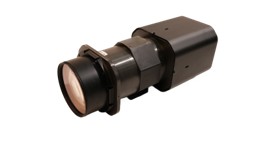
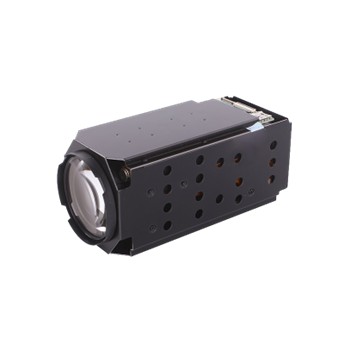
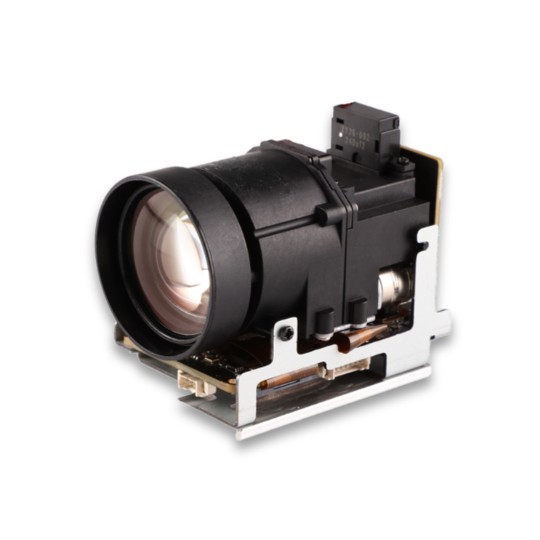
ZanVision offers four global shutter zoom camera modules tailored to different mission profiles:
3MP 86× Ultra Long-Range — for border surveillance and maritime ISR at extreme standoff distances
3MP 52× Long Range — balanced performance for multi-role EO/IR platforms
3MP 30× Mid-Range — compact PTZ integration for counter-drone and perimeter surveillance
3MP 10× Compact — SWaP-optimized for UAV gimbals and handheld ISR devices
Explore the full VIS/NIR Zoom Block Camera lineup for OEM integration.
Frequently Asked Questions
What is the difference between global shutter and rolling shutter?
A global shutter sensor exposes all pixels simultaneously, capturing the entire frame at the same instant. A rolling shutter scans line by line, which can create motion skew, wobble, and geometric distortion when tracking fast-moving targets. For counter-UAS, drone navigation, and high-speed inspection, global shutter ensures each frame represents the true scene geometry.
Why is global shutter important for counter-UAS systems?
Counter-UAS systems must detect, identify, and track small, fast-moving drones — often at long zoom ranges where even minor distortions are magnified. Rolling shutter artifacts degrade AI detection accuracy and tracking stability. Global shutter eliminates these artifacts, providing clean, distortion-free frames that improve both human operator assessment and machine vision algorithm performance.
What zoom ranges are available for global shutter camera modules?
ZanVision offers global shutter zoom modules spanning 10× to 86× optical zoom: the 10× compact model for UAV integration, 30× for standard PTZ deployments, 52× for long-range surveillance, and 86× for ultra-long-range border and maritime ISR applications.
Can global shutter cameras be integrated with thermal imaging?
Yes. ZanVision global shutter visible-light modules are designed for multi-sensor fusion with LWIR thermal imagers in EO/IR payloads. The 52× and 86× models (317mm and 860mm tele focal lengths) are commonly deployed in dual-spectrum gimbal systems, combining a 3MP global shutter visible camera with a 640×512 VOx thermal imager and optional laser rangefinder for all-weather, day/night operation.