


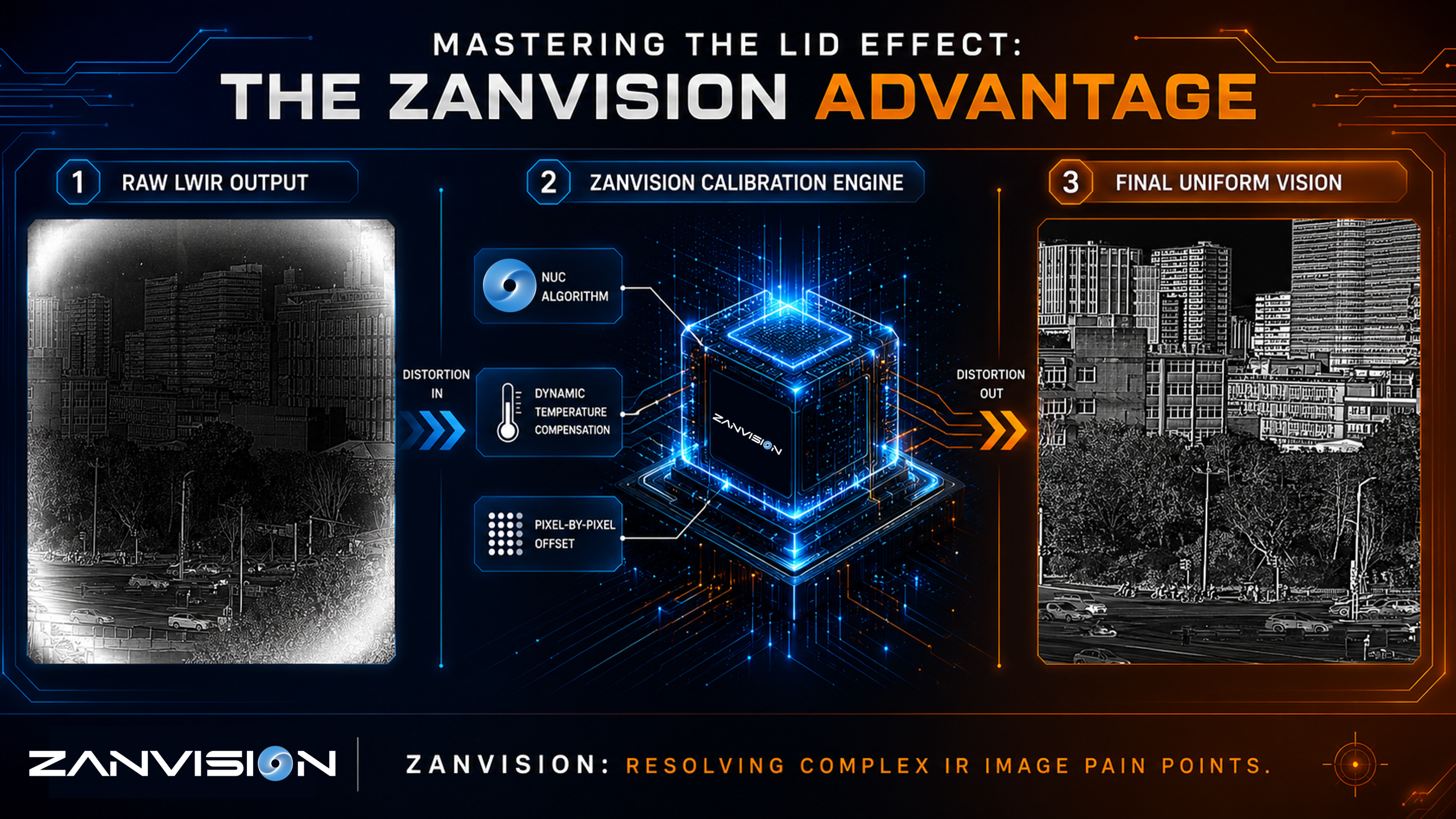
When operating infrared thermal cameras or integrating optoelectronic systems, have you encountered images with abnormally bright edges and a dark, recessed center? This phenomenon, which makes the image look like it's covered by a lid, is known in the industry as the "Lid Effect" (also called the Central Hotspot Effect).
This is not a random glitch but a critical "hidden killer" of image quality. For high-precision applications in defense and security, understanding its physical causes is the first step toward achieving professional-grade thermal vision.
1. Deep Dive: What Exactly is the "Lid Effect"?
The Lid Effect refers to an abnormal grayscale distribution in IR images caused by inconsistencies in the Focal Plane Array (FPA) response and thermal radiation from the lens structure.
Core Causes:
Internal Thermal Radiation: As the device operates, internal circuitry and housing generate heat. The edges of the FPA often become warmer than the center, causing the detector to pick up more background radiation at the periphery.
Optical Structure Impact: IR radiation passing through the lens and shutter is affected by the thermal signature of the lens barrel itself. In uncooled Long-Wave Infrared (LWIR) systems, the lens itself emits infrared radiation that reflects onto the detector array, further aggravating edge brightness.
2. Why It Matters: The High Stakes of Imaging Artifacts
For Zanvision's core clientele in defense and perimeter security, the Lid Effect is more than just a visual nuisance—it is an operational risk:
Failure in Target Tracking: In EO/IR Gimbals and Counter-UAS systems, bright edges wash out target details. AI algorithms can easily lose lock or misidentify artifacts as targets.
Compromised Tactical Judgment: For professional Thermal Rifle Scopes, shooters require total clarity. Dark spots or halos can lead to misjudgments in complex environments.
Loss of Perimeter Data: In border security, bright halos can mask intrusion attempts at the edges of the field of view, leaving critical security gaps.
3. The Solution: Zanvision’s Algorithmic Excellence
At Zanvision (Zanvision Tech), we solve the Lid Effect through a synergy of hardware optimization and deep calibration algorithms. Our approach moves beyond simple filtering to address the root cause:
Dynamic Non-Uniformity Correction (NUC): Our LWIR modules utilize proprietary algorithms to perform real-time pixel-by-pixel correction, ensuring a flat and uniform image field without the need for constant shutter calibration.
Adaptive Temperature Compensation: By monitoring internal core temperatures in real-time, Zanvision modules maintain image uniformity from cold-start to full thermal equilibrium, even in harsh environments from -40°C to +60°C.
High Fidelity Preservation: Our algorithms are designed to eliminate artifacts while preserving the minute temperature differences (NETD) essential for intelligent recognition and long-range detection.
4. Empowering the Future of Thermal Vision
Whether it is for high-altitude drone payloads, border defense, or industrial automation, Zanvision is committed to delivering the hardest-hitting imaging performance in the industry. By resolving the fundamental pain points of IR imaging, we ensure our clients always see the full picture.
Interested in enhancing your IR imaging quality?Experience the clarity of Zanvision's advanced thermal modules. Visit zanvisiontech.com to explore our LWIR modules and EO/IR solutions, or contact our technical team for a professional evaluation.