


1. Problem Context
The Infrared Cut-off Filter (IR CUT Filter) is a critical component within camera modules. This requirement arises due to the differing spectral responses of the human eye and a CMOS image sensor. While the human eye is insensitive to infrared (IR) radiation, the sensor can detect it efficiently (refer to the diagram below illustrating the photoelectric conversion efficiency and spectral response curve for a typical sensor). Consequently, an IR Cut Filter is necessary to block infrared light, thereby eliminating its adverse effects on image sensor capture and producing an output image aligned with human visual perception.
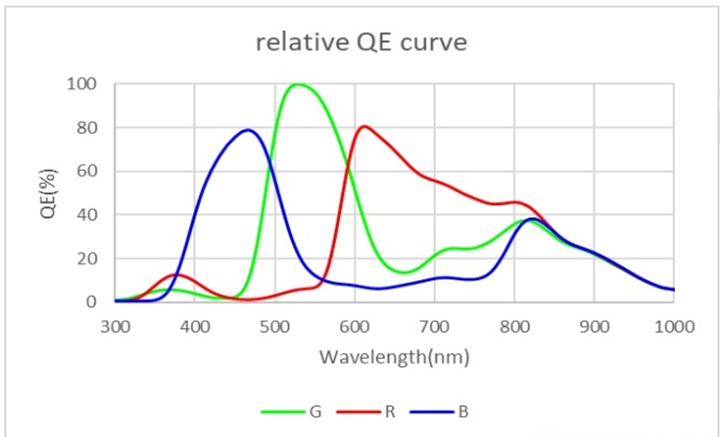
Device selection necessitates matching the filter specifications to the specific application scenario of the product. For instance, cameras deployed in surveillance systems, video conferencing equipment, laptops, or tablets produce images primarily for human visual assessment. Such applications require filters exhibiting high transmission within the visible spectrum (400–700 nm) and effective cut-off in the near-infrared region (700–1100 nm). This spectral profile ensures the elimination of IR interference and delivers perceptually correct images.
Conversely, cameras used in machine vision applications capture images intended for algorithmic analysis, recognition, or detection. These scenarios often demand bandpass filters transmitting only specific, designated wavelength bands while blocking light outside this designated passband (the spectral region where light is effectively transmitted is termed the "passband").
Typically, these filters are mounted directly behind the camera lens assembly, as depicted in Figures 1 and 2. Within security/surveillance camera modules, the lens holder often incorporates an IR_CUT switching mechanism, shown in Figure 3. This mechanism houses two filters: an IR cut-off filter and a clear (uncoated) optical element. During daylight hours, the IR cut-off filter is engaged. At night, the system switches to the clear element. Given this operational diversity, categorising the types of IR filters and understanding their application-specific implementation become the focal points of this summary.
2. Analysis of Filter Types and Applications
2.1 Types of IR Cut Filters: IR Cut-off Filters can be broadly categorised into two types based on their operational principle:
- Reflective Type: Conventional IR CUT Filters achieve spectral selectivity primarily through thin-film interference. These filters exhibit high transmission coupled with low reflection within the visible band, while demonstrating the inverse characteristics (low transmission, high reflection) in the infrared region.
- Absorptive Type (Blue Glass): Blue Glass is inherently an absorptive filter material. It relies on copper ions dissolved within the glass matrix to absorb infrared radiation.
It is noteworthy that standard IR cut filters, manufactured by depositing IR-cut coatings onto conventional optical glass substrates, are generally suitable only for lower-resolution cameras (typically less than 8 Megapixels). For high-resolution modules exceeding 8 Megapixels, Blue Glass IR cut filters are increasingly superseding coated optical glass due to superior performance requirements.
2.2 Application Scenarios in Specific Projects: The selection criteria for IR filters are best illustrated through representative project examples:
- a. Security/Surveillance Camera: Specifications and spectral transmission curves for an IR CUT assembly in a typical security camera are provided. This system employs two distinct filters operating in a switched configuration corresponding to lighting conditions:
- Day Mode: Utilises the IR Cut Filter. This filter achieves transmission exceeding 90% within approximately 440-600 nm of the visible spectrum, while effectively blocking near-infrared radiation from 700 nm to 1100 nm.
- Night Mode / Low-Light: Automatically switches to the clear optical glass element. This allows transmission exceeding 90% across a broad spectrum from 400 nm to 1100 nm. Under these conditions, infrared illuminators (IR LEDs) are typically activated to provide supplemental illumination. As imaging occurs in monochrome during night mode, IR radiation can effectively reach the sensor to form the image, and colour reproduction is irrelevant. Consequently, distinct sets of image processing parameters must be calibrated for day and night operation modes.
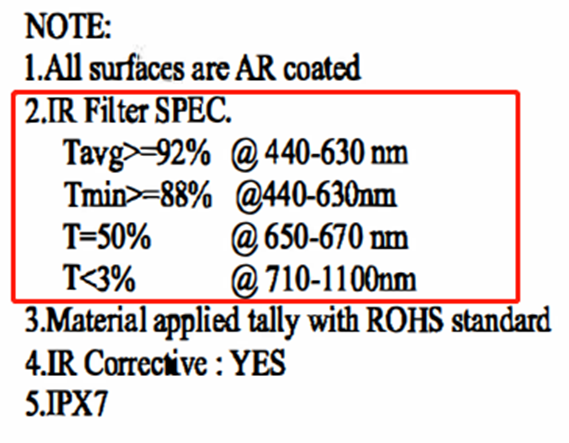
- b. Video Conference Camera: Specifications for an IR CUT Filter integrated within a video conferencing camera module are shown. Here, the filter is fixed directly behind the lens. This design features a Day Mode Only filter optimised for visible light imaging (400–630 nm transmission, 700–1100 nm cut-off). Image quality under very low light or night-time conditions is consequently suboptimal.
c. Machine Vision Camera (Face Detection): The spectral transmission curve provided depicts a filter designed for a specific machine vision task: face detection. This filter permits transmission within a narrow near-infrared band (810-870 nm) while blocking visible light. This filter was implemented in a dual-camera access control system performing both face detection and recognition. The filter described resides in the face detection camera, utilising a standard Bayer-pattern CMOS sensor. Crucially, as imaging relies solely on IR illumination, the resulting images are monochromatic. The rationale for this filter selection is that visible light imaging for face detection is significantly susceptible to environmental variability, leading to reduced detection rates.